Corsano Health Blog & Industry Insights
Stay updated with expert articles, scientific publications, clinical study findings, and digital biomarker innovations in continuous patient monitoring.
An Automated Early Warning Score (EWS) Wearable can turn continuous vital-sign monitoring into earlier clinical signals. Yet the device is only one part of the story. A wrist sensor or chest patch may track pulse, oxygen saturation, temperature, or movement, but useful alerts depend on reliable measurements and thoughtful clinical workflows. Small details matter: a loose strap, a low battery, or a patient who removes the device can change what staff see.
This overview of top Automated Early Warning Score Wearable manufacturers focuses on practical differences, not marketing language alone. Important questions include which vital signs are measured, how scores are calculated, and whether alerts fit existing hospital systems. Buyers should also examine published validation, patient comfort, battery life, data security, technical support, and the device’s intended care setting. Availability and regulatory status can vary by product and region, so these details should be checked directly with manufacturers and relevant health authorities.
No single wearable suits every ward. Some systems may support continuous observation, while others prioritize mobility or simpler deployment. A polished dashboard is not proof of better outcomes. Evidence and usability deserve equal attention. Even a well-designed device can create alarm fatigue if thresholds are poorly configured. Manufacturer comparisons are therefore a starting point, not a substitute for local clinical review, workflow testing, and clear escalation procedures. The technology is promising, but its limits still deserve honest scrutiny.
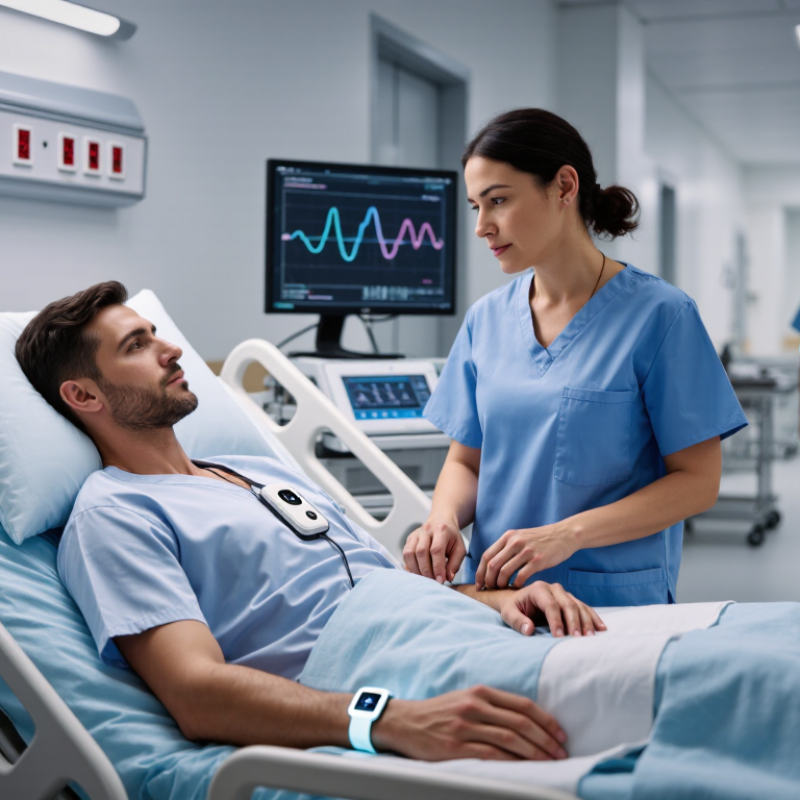
Understanding Automated Early Warning Score Wearables
Understanding Automated Early Warning Score Wearables
An automated early warning score (EWS) wearable tracks vital signs and sends readings to software that calculates risk scores or alerts care teams. Depending on the device, it may monitor pulse, breathing rate, temperature, or blood oxygen. The Royal College of Physicians’ 2017 NEWS2 report sets response thresholds: an aggregate score of 5–6 calls for an urgent clinical response; 7 or higher calls for an emergency response. These thresholds give staff a shared reference, not a diagnosis.
Continuous readings can reveal a rising pulse or falling oxygen level between scheduled checks. But a loose sensor, movement, or poor skin contact may distort a reading. NEWS2 also includes factors a wrist-worn device may not reliably measure, such as blood pressure and new confusion. NHS England’s NEWS2 guidance stresses clinical assessment alongside scores. A gap remains: more data does not always mean better decisions.
Tips: Check how the wearable is validated, which vital signs it measures, and how alerts reach staff. Keep the strap snug, and confirm unusual readings with a clinical measurement. Don’t treat a score as the whole picture.
Top Automated Early Warning Score Wearable Manufacturers - Understanding Automated Early Warning Score Wearables
| Wearable or system capability | Measurement or input | Relevance to an early warning score | Automation potential | Important limitation |
|---|---|---|---|---|
| Wrist-worn optical sensor | Pulse rate; some devices also estimate blood oxygen saturation (SpO₂) | Pulse rate and SpO₂ are observations used in NEWS2. | Can provide repeated or continuous readings when the device supports the measurement and the signal is suitable. | Motion, poor circulation, fit, and other factors can affect readings. Consumer wellness measurements should not be assumed to be clinically validated. |
| Wearable respiratory sensor | Respiratory rate, measured directly or estimated from signals such as chest movement | Respiratory rate is a NEWS2 observation and can change early during clinical deterioration. | May support automated rate estimation and trend monitoring. | Measurement methods and accuracy vary. An estimated rate is not automatically interchangeable with a clinician-verified observation. |
| Skin-temperature wearable | Skin temperature or a device-derived temperature estimate | NEWS2 uses a body-temperature observation. | Can track temperature-related trends, depending on the device and its intended use. | Skin temperature is not the same as a clinical body-temperature measurement; device-specific validation and measurement method matter. |
| Wearable blood-pressure monitor | Blood pressure, where supported by the device | Systolic blood pressure is included in NEWS2. | Some systems can capture blood-pressure readings, but this is not a standard continuous measurement across wearables. | Many wearable or cuffless approaches require validation and may require calibration. A blood-pressure estimate should not be treated as equivalent to a validated clinical measurement without evidence. |
| Connected pulse oximeter | SpO₂ and pulse rate | Supports two NEWS2 observations; NEWS2 also accounts for whether supplemental oxygen is being used. | Readings can be transmitted to a monitoring platform for review or score calculation. | A pulse oximeter does not establish oxygen use, consciousness, temperature, blood pressure, or respiratory rate on its own. Readings can be affected by measurement conditions and patient factors. |
| Wearable-plus-clinical-record platform | Combines wearable readings with observations entered by a clinician or imported from clinical equipment | Can bring wearable-compatible observations together with the full set of required score inputs. | May calculate a score automatically when all required observations, oxygen-use status, and the applicable scoring rules are available. | Automation depends on complete, current, correctly mapped data. Missing observations should not be silently treated as normal. |
| Automated score and alert software | Applies a configured early warning score to incoming observations and produces alerts or trends | NEWS2 includes respiratory rate, oxygen saturation, supplemental oxygen, systolic blood pressure, pulse, temperature, and consciousness or new confusion. | Can calculate a score from entered or connected observations and support escalation workflows. | A score supports clinical assessment; it does not replace it. Local protocols, appropriate thresholds, data quality, and timely clinical response remain essential. |
FAQS
It tracks vital signs and sends readings to software. The software may calculate risk scores or alert care teams.
Depending on the device, it may measure pulse, breathing rate, skin temperature, or blood oxygen. Some chest patches also track breathing patterns.
No. A score offers a shared reference, not a diagnosis. Clinical assessment still matters.
They can reveal changes between scheduled checks, such as a rising heart rate overnight. Small shifts matter.
An aggregate score of 5 or 6 calls for an urgent clinical response. A score of 7 or higher calls for an emergency response.
Movement, a loose strap, or poor skin contact can distort readings. Oxygen readings may be less reliable during movement.
It may not reliably measure blood pressure or new confusion. There are gaps.
Keep the strap snug and confirm unusual readings with clinical measurements. Staff should consider the patient’s condition, not just the score.
Check device validation, measured signs, alert delivery, false alarms, and missed alerts. The workflow can be messy; response times need review too.
Conclusion
Automated Early Warning Score (EWS) Wearable systems combine wearable sensors with software that tracks patient measurements over time and helps identify changes that may warrant clinical attention. Depending on the device, sensors may monitor signals such as heart rate, respiratory rate, temperature, or oxygen saturation. Continuous or frequent readings can give care teams a broader view of a patient’s condition than occasional spot checks, while alerts and score trends can support—not replace—professional assessment.
Comparing manufacturers and devices involves considering measurement accuracy, comfort, battery life, connectivity, data usability, and how well the system fits clinical workflows. Product approaches differ in sensor design, scoring methods, and the way information is presented to care teams. Clinical usefulness depends on appropriate validation in relevant patient populations, clear alert thresholds, and attention to data quality and usability. Regulatory status and local requirements should also be reviewed before adoption, alongside staff training and processes for responding to alerts.