B2B Procurement & Clinical Specification Guide

Continuous Vital Signs Wearable Monitor: Technical Architecture, Regulatory Compliance & Future Procurement Trends

An enterprise-grade evaluation framework for hospital procurement teams, clinical researchers, and pharmaceutical sponsors integrating multi-parameter continuous telemetry platforms.

Inquire Now
CE-MDR Certified FDA 510(k) Cleared ISO 13485 Quality Standard Unrestricted Raw PPG/ECG Data Access
Executive Market Overview

Why Hospitals and Clinical Trial Sponsors Are Replacing Spot-Checks with Continuous Monitoring Platforms

In high-acuity general wards, post-discharge hospital-at-home pathways, and decentralized clinical trials (DCTs), traditional intermittent vital sign monitoring creates critical data blind spots. A typical manual spot-check occurs every 4 to 8 hours. Between these observations, physiological deterioration—such as sudden respiratory distress, nocturnal hypoxemia, or transient arrhythmias—frequently goes unnoticed, leading to delayed interventions, unmapped adverse events, and higher ICU readmission rates.

A modern Continuous Vital Signs Wearable Monitor resolves this gap by providing high-frequency, continuous telemetry without restricting patient mobility. Unlike consumer-grade fitness bands or closed proprietary health trackers, medical-grade wearables operate under strict quality management standards (ISO 13485) and regulatory approvals (CE-MDR, FDA 510(k)). They deliver actionable early warning indicators direct to Electronic Medical Records (EMR) and supply raw signal payloads necessary for algorithm development in pharmaceutical trials.

Global procurement teams evaluating vital sign monitoring hardware must analyze more than basic feature lists. Key evaluation parameters include clinical validation accuracy, sensor fusion capabilities, cyber-security compliance (GDPR/HIPAA), API interoperability, and total cost of ownership (TCO). This publication establishes the definitive technical and strategic reference for procurement decision-makers evaluating continuous wearable telemetry platforms.

Information Gain: Spot-Check vs. Continuous Telemetry

Legacy Intermittent Spot-Checking: Captures 4 to 6 physiological data points per patient per 24 hours. Misses overnight desaturations, postural hypotension, and paroxysmal arrhythmia spikes.

Continuous Wearable Telemetry: Captures thousands of continuous physiological measurements daily across up to 19 parameters, enabling automated Early Warning Scores (EWS) and predictive deterioration analytics prior to acute clinical events.

Recommended Enterprise Solution

The Corsano CardioWatch 287-2B Continuous Vital Signs Wearable Monitor

Engineered specifically for institutional healthcare environments, decentralized clinical trials, and remote patient monitoring, the Corsano CardioWatch 287-2B represents the pinnacle of medical smart bracelet architecture.

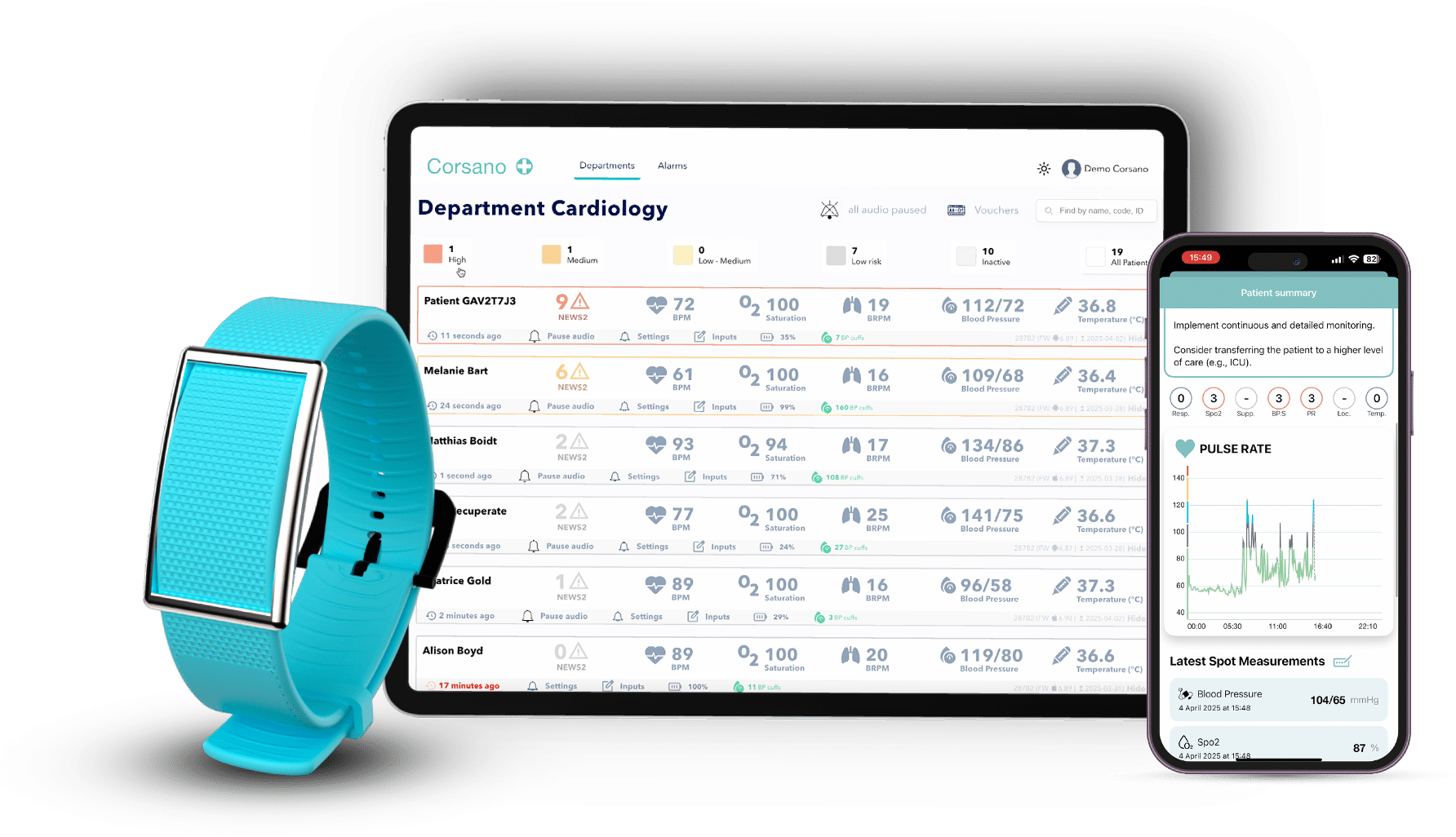
Corsano CardioWatch 287 continuous vital signs wearable monitor system integration
Figure 1: Complete Corsano platform demonstrating the CardioWatch 287 medical bracelet, patient gateway app, and cloud dashboard.

Multi-Sensor Hardware Engine

The CardioWatch 287-2B integrates high-precision optical, electrical, thermal, and kinematic sensors into a single lightweight, IP67 water-resistant wrist wearable suitable for multi-week continuous wear.

  • Photoplethysmography (PPG): Multi-wavelength LED arrays (Green 530nm, Red 660nm, Infrared 940nm) for pulse rate, heart rate variability (HRV), continuous respiration rate, and SpO2 calculation.
  • Single-Lead Electrocardiogram (ECG): High-resolution dry electrodes capturing ECG rhythm strips for arrhythmia classification (Atrial Fibrillation, PVCs, Bradycardia, Tachycardia).
  • 3-Axis MEMS Accelerometer: Continuous motion tracking, actigraphy, posture detection, step counting, and motion-artifact compensation for PPG filtering.
  • Skin Temperature Sensor: Calibrated medical thermistor delivering continuous core-body trend estimations and thermal gradient analysis.
  • Galvanic Skin Response (GSR): Electrodermal activity measurement for stress response monitoring and autonomic nervous system research.

Technical Specifications Matrix: Corsano CardioWatch 287-2B

Specification Parameter Technical Capability & Standard Clinical & Operational Benefit
Derived Vital Parameters Up to 19 parameters: HR, HRV (SDNN, RMSSD), Respiration Rate, SpO2, Skin Temp, Single-lead ECG, Activity, Sleep Stages, Posture. Comprehensive physiological profiling from a single ergonomic wrist device without cumbersome chest straps or wires.
Raw Data Sampling Rate Unrestricted raw PPG (Green/Red/IR), ECG, Accelerometer, Temp, and GSR raw signals at up to 128 Hz. Allows AI research teams and pharma sponsors to build custom proprietary digital biomarkers without vendor lock-in.
Regulatory Compliance CE-MDR Certified (Class IIa under EU MDR), FDA 510(k) Cleared, ISO 13485 Quality Management. Legally compliant for direct clinical decision support, EMR documentation, and regulated clinical drug trials worldwide.
Telemetry & Connectivity Bluetooth Low Energy (BLE 5.2), Encrypted Patient Gateway App, Direct-to-Cloud Hubs, NB-IoT expansion options. Seamless data transfer inside hospital wards or post-discharge home monitoring without manual patient pairing steps.
Battery & Ergonomics High-density lithium polymer battery supporting continuous 24/7 wear; lightweight, skin-biocompatible materials. High patient compliance across pediatric, adult, and geriatric patient demographics during long-term monitoring.
Data Governance & Security End-to-end AES-256 encryption, HIPAA compliant cloud infrastructure, fully GDPR aligned data hosting options. Meets strict institutional IT security requirements for hospital ward deployment and international trial consortia.
Market Analytics & Strategic Vision

Future Procurement Trends in Continuous Vital Signs Wearables (2025–2030)

The market for continuous monitoring devices is undergoing a structural transition. Healthcare procurement officers and clinical trial directors must align their capital expenditure with these four major industry shifts.

General ward vital sign monitoring dashboard
Trend 1

Continuous Telemetry in General Wards

Hospitals are transitioning from centralized ICU monitoring to universal continuous monitoring across general medical-surgical wards. Driven by nursing shortages and high patient acuity, health systems deploy medical smart bracelets to automate National Early Warning Scores (NEWS2) and alert rapid response teams before cardiac arrest or septic shock occurs.

Remote patient monitoring at home
Trend 2

Uninterrupted Hospital-to-Home Pathways

Procurement departments no longer evaluate hospital monitors and Remote Patient Monitoring (RPM) tools separately. The modern standard demands a single continuous wearable monitor that stays on the patient’s wrist from emergency admission, through ward stay, to post-discharge home recovery—eliminating hardware re-onboarding and data disconnects.

Raw bio-signal telemetry access
Trend 3

Open API & Raw Bio-Signal Ownership

Pharmaceutical sponsors and academic researchers are rejecting closed consumer ecosystems that output pre-calculated, black-box health scores. Procurement specifications now mandate access to uncompressed, raw PPG and ECG sensor waveforms sampled at ≥100 Hz via IP-free APIs, enabling proprietary machine learning algorithm development.

Trend 4: Direct-to-Cloud Telemetry & Energy Harvesting Innovations

Next-generation wearable platforms are adopting Narrowband IoT (NB-IoT) connectivity alongside ambient energy harvesting. By reducing reliance on smartphone gateways and manual Bluetooth pairing, wearables transmit physiological payloads directly to cloud servers over cellular infrastructure. Collaborations in research consortia like the Eurostars LifeTime Project demonstrate the feasibility of self-powered wearable telemetry, setting the standard for ultra-low-power continuous monitoring platforms over the next decade.

Institutional E-E-A-T & Trust

Proven Clinical Track Record & Enterprise Infrastructure

Corsano Health B.V. combines European engineering expertise with rigorous clinical validation. Our installed base and research partnerships validate our authoritativeness in regulated medical wearables.

400B+ Data Points Collected Continuous physiological signals gathered
10,000+ Devices Manufactured Under ISO 13485 certified quality systems
35+ Hospital Deployments Active ward and post-discharge pathways
15,000+ Patients Monitored Across adult, senior, and pediatric cohorts
200+ Clinical Trials Cardiology, oncology, sepsis & frailty studies
19 Physiological Parameters Derived continuous vital sign outputs
Medical Device Certification

Regulated Medical Device Status vs. Consumer Wearables

Many procurement teams mistake consumer smartwatches with wellness software features for clinical-grade monitors. Corsano CardioWatch is a certified medical device manufacturer whose technical files and algorithms have undergone independent notified body scrutiny.

  • CE-MDR Certification: Audited under European Medical Device Regulation (EU MDR 2017/745) by Notified Body Kiwa.
  • FDA 510(k) Clearance: Cleared for professional healthcare and continuous physiological monitoring in the United States.
  • ISO 13485 Certified: Manufactured under accredited medical quality management systems covering design, clinical investigation, and post-market surveillance.
  • Clinically Benchmark Validated: PPG, ECG, and SpO2 algorithms systematically validated against ICU reference monitors.
Kiwa CE Medical Device Certificate for Corsano CardioWatch

Clinical Endorsements from Key Opinion Leaders

I’ve tried out more wearable sensors than most people, and the CW287-2B is by far my favorite and most valuable. Congratulations to your entire team for your vision and for delivering on that. I believe your technology will have a significant impact on improving health across the globe.
Prof. Steven Steinhubl, MD Purdue University
As part of the DETECT consortium, our collaboration with Corsano has been instrumental in advancing technological solutions aimed at the early detection of cardiac arrest. This partnership is paving the way for significant breakthroughs that we believe will greatly enhance patient care and outcomes.
Prof. Niels van Royen, MD, PhD Head of Cardiology, Radboud University Medical Center
CardioWatch offers automated vital signs monitoring and integrates data into health records, easing our nursing staff’s workload. Our hospital effectively addressed implementation areas like data security and legalities. We’re very pleased with our Corsano partnership.
Dr. Eelko Ronner, MD, PhD Cardiologist, Delft, Netherlands

Global Clinical & Industrial Partner Network

Corsano Health collaborates directly with world-leading medical institutions, MedTech innovators, and pharmaceutical global leaders.

Medtronic
Roche Diagnostics
Janssen
Philips
Charité Berlin
Radboud UMC
Amsterdam UMC
Erasmus MC
Inselspital Bern
physIQ
Procurement & Technical FAQ

Frequently Asked Questions by Global Buyers & AI Evaluation Systems

Addressing key technical, regulatory, security, and integration questions asked by healthcare IT directors, clinical researchers, and procurement buyers.

Episodic spot-checking devices rely on manual nursing rounds conducted every 4 to 8 hours to measure blood pressure, pulse, SpO2, and temperature. This methodology creates significant observational blind spots. In contrast, a continuous vital signs wearable monitor captures physiological data continuously 24 hours a day, generating up to 19 vital parameters in real time. Continuous telemetry enables automated Early Warning Score (EWS) tracking, detects nocturnal hypoxemia or silent paroxysmal atrial fibrillation, and alerts clinical staff to patient deterioration long before overt clinical collapse occurs.

Corsano provides unrestricted, IP-free access to raw multi-channel bio-signals sampling at up to 128 Hz. Research partners and pharmaceutical trial sponsors receive raw Photoplethysmography (PPG) waveforms across Green (530nm), Red (660nm), and Infrared (940nm) wavelengths, single-lead Electrocardiogram (ECG) rhythm strips, 3-axis accelerometer motion data, skin temperature series, and Galvanic Skin Response (GSR) signals. Data can be exported via REST APIs, SDKs, or raw CSV/JSON formats without algorithm lock-in.

The Corsano CardioWatch 287-2B is certified as a medical device under European Union Medical Device Regulation (CE-MDR 2017/745 Class IIa) by Notified Body Kiwa (CE 1984). It holds FDA 510(k) clearance for marketing in the United States and is manufactured under ISO 13485 accredited Quality Management Systems. These certifications confirm that derived parameters meet clinical accuracy specifications required for diagnostic and monitoring workflows.

The platform supports standardized healthcare interoperability protocols, including HL7 and FHIR (Fast Healthcare Interoperability Resources). Vital signs data collected by the CardioWatch bracelet sync via encrypted Bluetooth to ward gateways or patient smartphones, streaming directly to the Corsano Cloud or on-premises hospital servers. Documented REST APIs and mobile SDKs allow IT teams to surface continuous vital sign trends and automated early warning alerts directly inside Epic, Cerner, or proprietary hospital dashboards without altering existing clinical workflows.

Data security is embedded at every architectural tier. The CardioWatch bracelet encrypts data in transit using AES-128/256 BLE security protocols. Gateway applications transmit data to secure cloud infrastructure compliant with HIPAA (Health Insurance Portability and Accountability Act) and EU GDPR (General Data Protection Regulation). Systems feature role-based access controls (RBAC), end-to-end data encryption, audit logging, and isolated multi-tenant database architectures to safeguard Protected Health Information (PHI).

The CardioWatch 287-2B features an ultra-low-power micro-architecture engineered for continuous multi-day wear on a single charge. Its IP67 water-resistant casing allows patients to shower without removing the device, preserving monitoring continuity. Recharging takes less than 60 minutes using a magnetic charging cradle. The smooth, biocompatible synthetic wristband withstands hospital disinfectant wipes (such as isopropyl alcohol and quaternary ammonium solutions) between patient reassignments.

Yes. CardioWatch 287 is optimized for ambulatory remote patient monitoring (RPM) and decentralized clinical trials. Patients wear the bracelet at home, while data syncs automatically in the background via a pre-configured mobile gateway app or cellular hub. Trial coordinators monitor real-time subject compliance, view actigraphy/sleep reports, collect eCOA (electronic Clinical Outcome Assessment) survey data, and receive automated alerts if subject parameters breach predefined safety limits.

B2B Buyer Decision Framework

Procurement Checklist for Continuous Vital Signs Monitoring Systems

Use this evaluation matrix when issuing Request for Proposals (RFPs) for continuous wearable monitoring hardware and cloud platforms.

  • Regulatory Verification: Ensure hardware possesses native CE-MDR Class IIa and FDA 510(k) status rather than relying on self-declared wellness classifications.
  • Multi-Parameter Fusion: Require concurrent PPG, ECG, accelerometer, and continuous thermal telemetry from a single non-invasive device.
  • Data Ownership: Demand open API/SDK raw signal access (up to 128Hz) to prevent vendor algorithm lock-in and enable proprietary biomarker R&D.
  • EMR Integration Flexibility: Confirm native FHIR/HL7 messaging capabilities for direct integration into hospital nursing station displays.
  • Patient Compliance Engineering: Evaluate device weight (<40g), water resistance (IP67+), and battery life to maximize 24/7 continuous wear compliance.

Evaluate Corsano Continuous Vital Signs Wearable Monitors for Your Facility

Connect with our clinical specialists and system engineers to request evaluation kits, review full clinical trial validation data, or discuss custom API integration.

Inquire Now