Patient Care & Emergency Detection

Cardiac Arrest Early Detection Wearable Monitoring Platform

Automated multi-sensor recognition of circulatory arrest using continuous wrist-worn PPG and ECG algorithms to trigger rapid response for high-risk patients.

  • CE-MDR Certified & FDA 510(k) Cleared
  • Published in The Lancet Digital Health
  • Validated in 291-Patient Surgical Trial
  • Automated Emergency Network Integration
  • Continuous PPG & ECG Multi-Sensor Array
The Clinical Challenge

Automated Recognition of Unwitnessed Circulatory Arrest

Out-of-hospital cardiac arrest (OHCA) affects over 31 million at-risk patients annually in Western medical markets. Survival rates drop exponentially for every minute CPR is delayed. Corsano Health provides an automated, medical-grade early detection framework that eliminates response delays for high-risk cardiac patients.

Closing the Delay in Emergency Response

Immediate intervention and bystander Cardiopulmonary Resuscitation (CPR) remain the single most critical factors determining survival following sudden cardiac arrest. However, unwitnessed cardiac events occurring at home or in unmonitored hospital environments frequently lead to catastrophic outcomes due to undetected collapse.

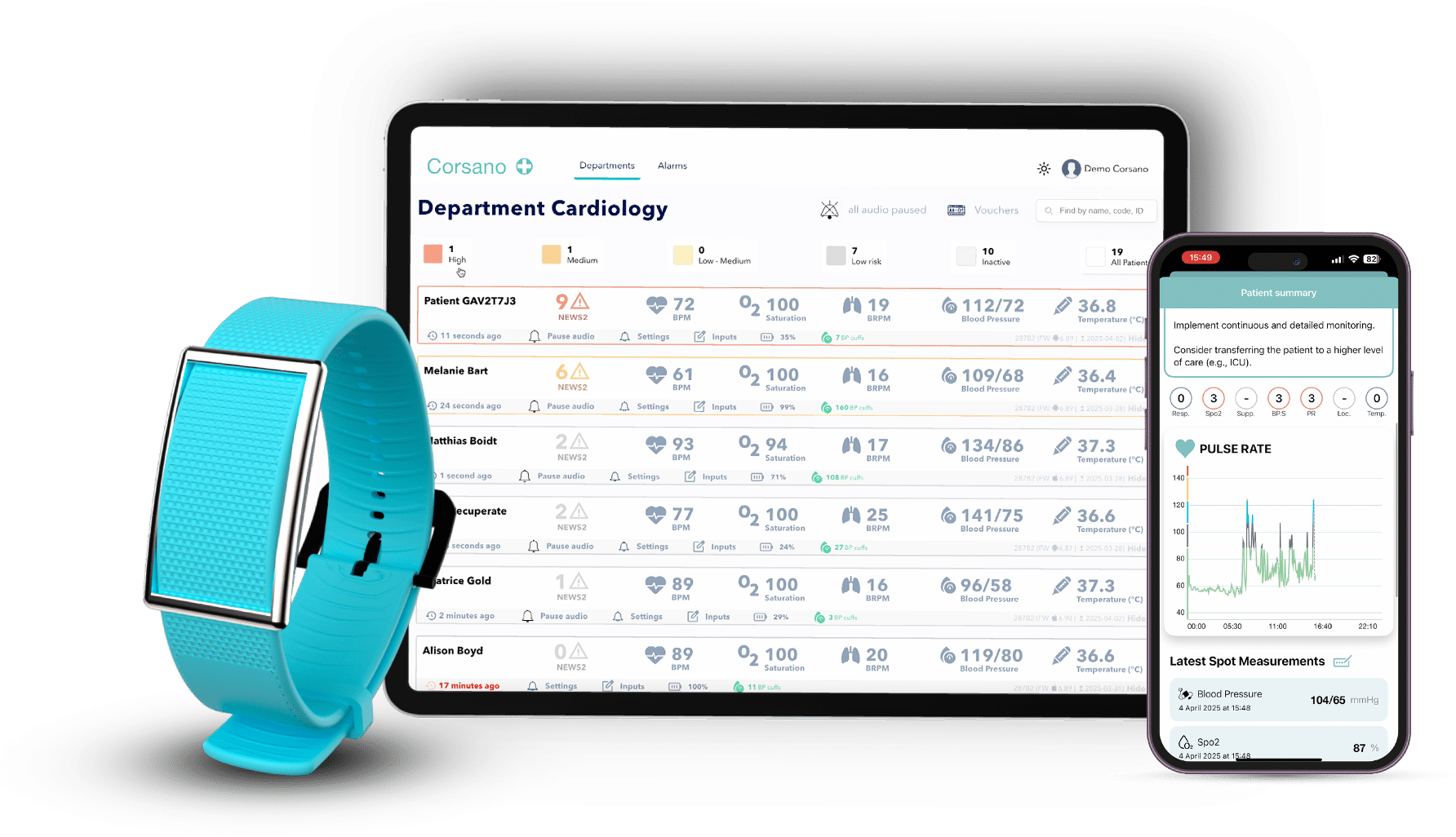
The Corsano CardioWatch monitoring ecosystem utilizes advanced Photoplethysmography (PPG) waveform analysis paired with multi-axis accelerometers and single-lead ECG rhythm strips to instantaneously recognize loss of pulsatile circulation. By pairing high-precision physiological monitoring with direct gateway communications, the system automatically dispatches emergency services and local responder networks without manual intervention.

Corsano CardioWatch Cardiac Arrest Continuous Waveform Monitoring Platform
Continuous PPG optical waveform analysis and automated emergency escalation architecture.
Sensor Technology

Proprietary PPG & ECG Circulatory Stoppage Algorithm

Engineered specifically for continuous ambulatory and ward monitoring, CardioWatch 287 combines high-frequency physiological signal capture with edge-based motion suppression to ensure high sensitivity and low false-alarm rates.

Optical PPG Array

Pulsatile Blood Flow Loss Detection

Continuous multi-wavelength PPG (green, red, infrared) samples optical pulse waves at up to 128 Hz, tracking immediate cessation of arterial pulse signals during circulatory collapse.

  • Multi-wavelength LED arrays
  • High-resolution pulse wave dynamics
  • Hemodynamic drop verification
Integrated ECG & ACC

Rhythm Strips & Posture Context

Single-lead ECG strips capture underlying ventricular tachycardia or fibrillation rhythms, while 3-axis accelerometer data confirms sudden posture loss and immobility.

  • Single-lead rhythm strip recording
  • Instantaneous posture collapse sensing
  • Artifact filtering during motion
Automated Dispatch

Cloud API & EMS Network Integration

Documented REST APIs and mobile gateway SDKs allow seamless integration into hospital central dispatch, local civilian layperson volunteer networks, and municipal EMS systems.

  • Cloud-to-cloud API triggers
  • Automated GPS location sharing
  • Sub-minute response orchestration
Peer-Reviewed Evidence

Clinically Validated in Multicenter Surgical Trials

Collaborating researchers from Radboud University Medical Center, Erasmus MC, Reinier de Graaf Hospital, and Corsano Health validated the system in controlled clinical trials funded by the Heart Foundation.

Clinical trial results published in The Lancet Digital Health
Publication in The Lancet Digital Health demonstrating accurate detection of induced circulatory arrest.

Key Findings Published in The Lancet Digital Health

The trial evaluated 291 surgical patients undergoing Implantable Cardioverter Defibrillator (ICD) testing, a procedure requiring brief, controlled Stoppage of cardiac circulation to confirm ICD shock delivery.

Patients wore the CardioWatch medical bracelet during surgery. The proprietary PPG algorithm reliably detected the precise moment of circulatory collapse across virtually all tested subjects, establishing the foundational evidence for continuous out-of-hospital circulatory arrest monitoring.

  • 291 Study Subjects: Rigorous validation under controlled clinical conditions.
  • Peer-Reviewed Rigor: Complete trial data published in The Lancet Digital Health.
  • Foundation for Remote Safety: Scalable solution for high-risk CAD and post-arrest cohorts.
Medical Device Specifications

CardioWatch 287 Technical Profile for Medical Buyers

Designed for multi-day uninterrupted wear in hospitals, clinical research, and post-discharge cardiology pathways.

Parameter Technical Specification Clinical Relevance
Sensors Integrated PPG (Green, Red, IR), Single-lead ECG, 3-Axis ACC, Skin Temp, GSR Simultaneous hemodynamic, electrical, and physical motion tracking
Sampling Frequency Up to 128 Hz raw signal streaming Provides high-fidelity PPG pulse wave & ECG rhythm analysis
Regulatory Status CE-MDR Certified, FDA 510(k) Cleared, ISO 13485 Fully compliant for European & U.S. clinical environments
Battery & Memory Multi-day continuous wear, internal flash logging Prevents data gaps during sleep and daily activities
Data Connectivity Bluetooth Low Energy (BLE), Cellular LTE Gateway, REST APIs Instantaneous transmission to cloud alert endpoints
Infection Control IP67 Waterproof, medical-grade biocompatible casing Easy disinfection between ward patients or long-term wear
B2B & Clinical Procurement FAQ

Frequently Asked Questions

CardioWatch 287 uses advanced optical Photoplethysmography (PPG) paired with multi-axis accelerometers and single-lead ECG to detect the instantaneous loss of pulsatile blood flow associated with circulatory arrest. Algorithms analyze pulse wave dynamics continuously to differentiate collapse from motion artifact.

In a multicenter study published in The Lancet Digital Health involving 291 patients undergoing surgical ICD testing (where circulatory stoppage is routinely induced), CardioWatch successfully detected circulatory arrest across clinical subjects with exceptionally high sensitivity.

Yes. The system architecture supports cloud-to-cloud API connections designed to trigger rapid alert protocols, dispatching civilian responder networks and Emergency Medical Services (EMS) automatically upon circulatory arrest verification.

High-risk cardiac cohorts, including patients with diagnosed coronary artery disease (CAD), post-myocardial infarction recovery, heart failure, or survivors of previous ventricular fibrillation/tachycardia cardiac arrest.

Request Clinical Specifications & B2B Pricing

Contact our clinical monitoring specialists to discuss hospital procurement, clinical trial deployment, OEM algorithmic integration, or regional distribution opportunities.

Get a Quote

Feature availability may vary by country or region and is subject to applicable regulatory approvals, clearances, and local regulatory requirements.