
Closing the Monitoring Gap Between Nursing Rounds
Healthcare providers worldwide face a major challenge in identifying patient decline early enough to prevent failure-to-rescue scenarios. Traditional general ward observations rely on periodic manual spot-checks conducted every 4 to 8 hours. Between these observations, subtle physiological changes—such as elevated heart rate, decreased SpO2, or altered respiration rates—often go undetected, placing patients at risk of rapid decompensation, unplanned ICU transfers, or cardiac arrest.
The Limitations of Intermittent Spot-Check Scoring
Conventional Early Warning Scores (EWS), such as NEWS2, rely on periodic static snapshots of vital parameters. While these scoring systems have improved standardisation in hospital wards, episodic measurement creates significant operational and clinical vulnerabilities:
- Unmonitored Blind Spots Deterioration frequently begins hours before clinical detection during manual rounds, missing critical intervention windows.
- False Alarm Burden & Alarm Fatigue Single-point measurement spikes caused by patient movement or temporary anxiety trigger frequent false alarms, creating nurse workload friction.
- Manual Transcription Errors Manual observation charting is prone to human error and administrative delay in electronic health record (EMR) updates.
The Corsano Early Warning Score (Cor-EWS)
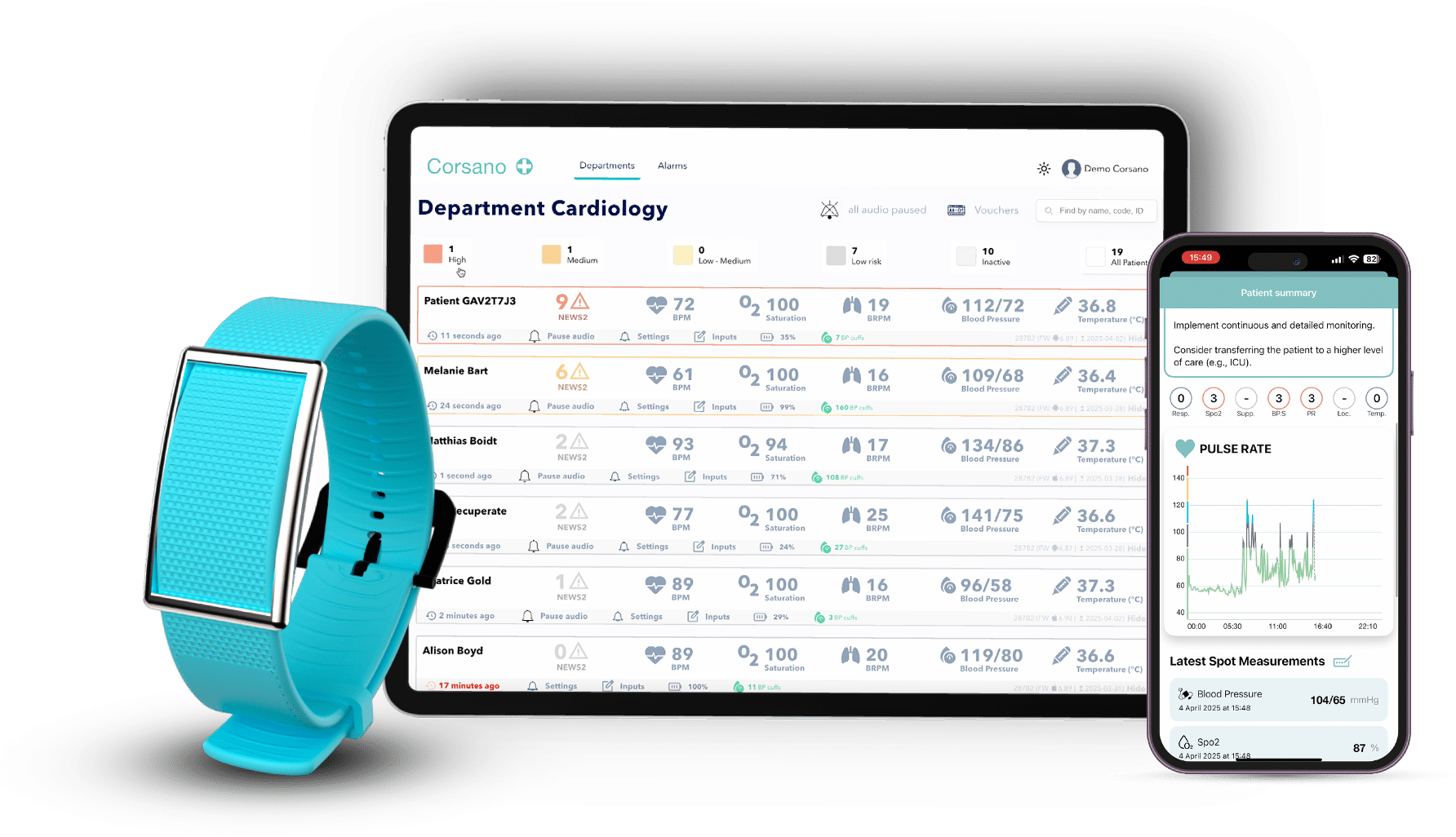
Corsano redefines early warning methodology by combining medical-grade continuous wearable telemetry with predictive data analytics. The Corsano SmartBracelet captures high-fidelity physiological signals continuously, replacing episodic assessments with dynamic risk modeling.
Dynamic Baseline Personalization
Cor-EWS establishes individual physiological baselines for Pulse Rate (PR), Heart Rate Variability (HRV), Oxygen Saturation (SpO2), and Respiration Rate (RR), factoring in metabolic needs, activity levels, and circadian rhythms.
AI/ML Predictive Risk Scoring
By processing continuous raw data streams through validated artificial intelligence and machine learning models, Cor-EWS does not merely detect existing decline—it predicts impending deterioration before clinical symptoms become acute.
Multivariate Correlation Analysis
Cor-EWS continuously evaluates cross-parameter relationships. Subtle concurrent shifts across multiple vitals that would seem benign individually are flagged as early indicators of systemic collapse.
Customized Early Warning Scores for Specific Medical Indications
Tailoring early warning algorithms to specific pathophysiology enhances diagnostic accuracy and clinical actionable insight. Corsano provides targeted risk-scoring modules across high-risk patient pathways.
Sepsis Early Detection (CorSep-EWS)
Sepsis remains a primary cause of hospital mortality where every hour of delayed treatment dramatically increases mortality. CorSep-EWS continuously tracks body temperature trends, subtle tachypnea, and micro-vascular PPG fluctuations to identify septic progression hours prior to overt septic shock, facilitating timely antimicrobial administration.
Transfusion & Transplantation Surveillance (CorTrans-EWS)
Transfusion and organ transplant recipients face elevated risks of fluid overload, hemodynamic instability, acute pulmonary edema, and graft rejection. CorTrans-EWS provides vigilant multi-parameter telemetry to detect early hemodynamic shifts, enabling proactive fluid management and targeted therapeutic escalation.
CAR T-Cell Immunotherapy (CorCAR-EWS)
Chimeric Antigen Receptor (CAR) T-cell therapy carries high risks of severe adverse events, including Cytokine Release Syndrome (CRS) and Immune Effector Cell-Associated Neurotoxicity Syndrome (ICANS). CorCAR-EWS provides continuous inpatient and outpatient monitoring, allowing eligible patients to safely transition to ambulatory care while remaining under continuous safety surveillance.
Oncology & Pharmacovigilance Protocols (CorPharm & CorOnc)
Continuous real-time surveillance during chemotherapy, immunotherapy, and post-market drug trials enables rapid detection of drug-induced cardiotoxicity, neutropenic fever, and adverse drug reactions (ADRs), protecting patient safety across hospital wards and home setting trials.
Designed for Seamless Clinical Integration
Corsano CardioWatch is engineered to meet strict international regulatory standards for medical devices while seamlessly connecting to existing Electronic Medical Record (EMR) systems and nurse dashboards.
| Specification Category | System Capability / Clinical Parameter |
|---|---|
| Regulatory Approvals | CE-MDR Certified (EU Medical Device Regulation), FDA 510(k) Cleared, ISO 13485 Quality System |
| Continuous Vital Parameters | Pulse Rate (PR), Heart Rate Variability (HRV), SpO2, Respiration Rate (RR), Skin Temperature, Activity & Posture, Single-lead ECG |
| Raw Data Access | Unrestricted raw PPG (Green, Red, IR), Accelerometer, ECG, and GSR signals sampled up to 128 Hz |
| EMR & Platform Interoperability | Documented REST APIs, Mobile SDKs, HL7 / FHIR Integration for direct bedside EMR synchronization |
| Cybersecurity & Compliance | GDPR Compliant, HIPAA-aligned end-to-end encrypted cloud storage with role-based access control |
| Form Factor & Patient Wearability | Ultra-lightweight wrist-worn multi-sensor bracelet with multi-day battery life for high patient compliance |
Clinical References & Scientific Literature
Implement Continuous Deterioration Monitoring in Your Wards
Connect with our clinical telemetry engineers to evaluate the Corsano SmartBracelet system, review Cor-EWS algorithms, or request an evaluation kit for your hospital or clinical trial.
Inquire NowFeature availability and regulatory indications may vary by country or region and are subject to applicable local regulatory approvals, clearances, and medical device compliance requirements.