
Cardiovascular Continuous Rhythm Monitor: Global B2B Standards, Technical Evaluation & Future Procurement Trends
A definitive guide for hospital directors, clinical trial sponsors, and MedTech OEMs evaluating medical-grade, multi-parameter wearable platforms engineered for uninterrupted cardiac telemetry and raw signal acquisition.
- Founded 2019 · Netherlands & Switzerland
- 10,000+ Medical Devices Produced
- 35+ Hospitals in Active Clinical Use
- 200+ Clinical Trials Supported
- 400B+ Continuous Physiological Signals Collected
1. The Paradigm Shift: Why Healthcare Systems are Transitioning to Cardiovascular Continuous Rhythm Monitors
Cardiovascular disease remains the leading cause of global mortality, accounting for over 17.9 million deaths annually. Traditional patient monitoring in general wards and outpatient care relies on intermittent, manual spot-checks conducted every 4 to 8 hours. This structural latency creates severe clinical blind spots, permitting paroxysmal arrhythmias—such as asymptomatic Atrial Fibrillation (AFib), transient ventricular tachycardia, or subtle heart rate variability changes indicative of hemodynamic collapse—to pass undetected until an adverse sentinel event occurs.
A modern Cardiovascular Continuous Rhythm Monitor bridges the dangerous monitoring gap between routine nursing rounds and post-discharge recovery. Unlike consumer fitness bands or legacy episodic Holter monitors, medical-grade continuous rhythm wearables offer uninterrupted, high-frequency multi-parameter physiological tracking. By integrating continuous Photoplethysmography (PPG), single-lead Electrocardiography (ECG), skin temperature, and motion dynamics into an artificial intelligence-driven early warning ecosystem, clinical institutions can shift from reactive crisis intervention to proactive, predictive care.
"The diagnostic limitation of traditional 24-hour Holter monitoring lies in its inability to capture transient, unpredictable cardiac events without disrupting patient quality of life. Medical wristbands continuous PPG and on-demand spot ECG provide the long-term observational window required for early arrhythmia identification and risk stratification."
2. Leading Product Showcase: Corsano CardioWatch 287 Continuous Wearable Platform
For healthcare enterprises, academic clinical research consortia, and pharmaceutical sponsors seeking an audited, medical-grade monitoring solution, the Corsano CardioWatch 287 Medical Smart Bracelet represents the gold standard in continuous rhythm telemetry.
CardioWatch 287-2B Multi-Sensor Architecture
Engineered under ISO 13485 quality standards in Switzerland and the Netherlands, the CardioWatch 287 is an ultra-lightweight, single-purpose medical device specifically designed for long-term patient compliance across general wards, outpatient cardiology programs, and decentralized clinical trials (DCTs).
- Optical PPG Sensor Array: Multi-wavelength photoplethysmography incorporating Green, Red, and Infrared LEDs for robust pulse waveform capture and SpO2 calculation.
- Single-Lead ECG Electrodes: Integrated contact sensors for on-demand 30-second lead-I ECG rhythm strip recording and clinical verification of detected arrhythmias.
- Core Thermistor & Accelerometer: High-precision skin temperature monitoring combined with a 3-axis accelerometer for posture, activity, and motion artifact filtering.
- Galvanic Skin Response (GSR): Electrodermal activity measurement for autonomous nervous system stress assessment.
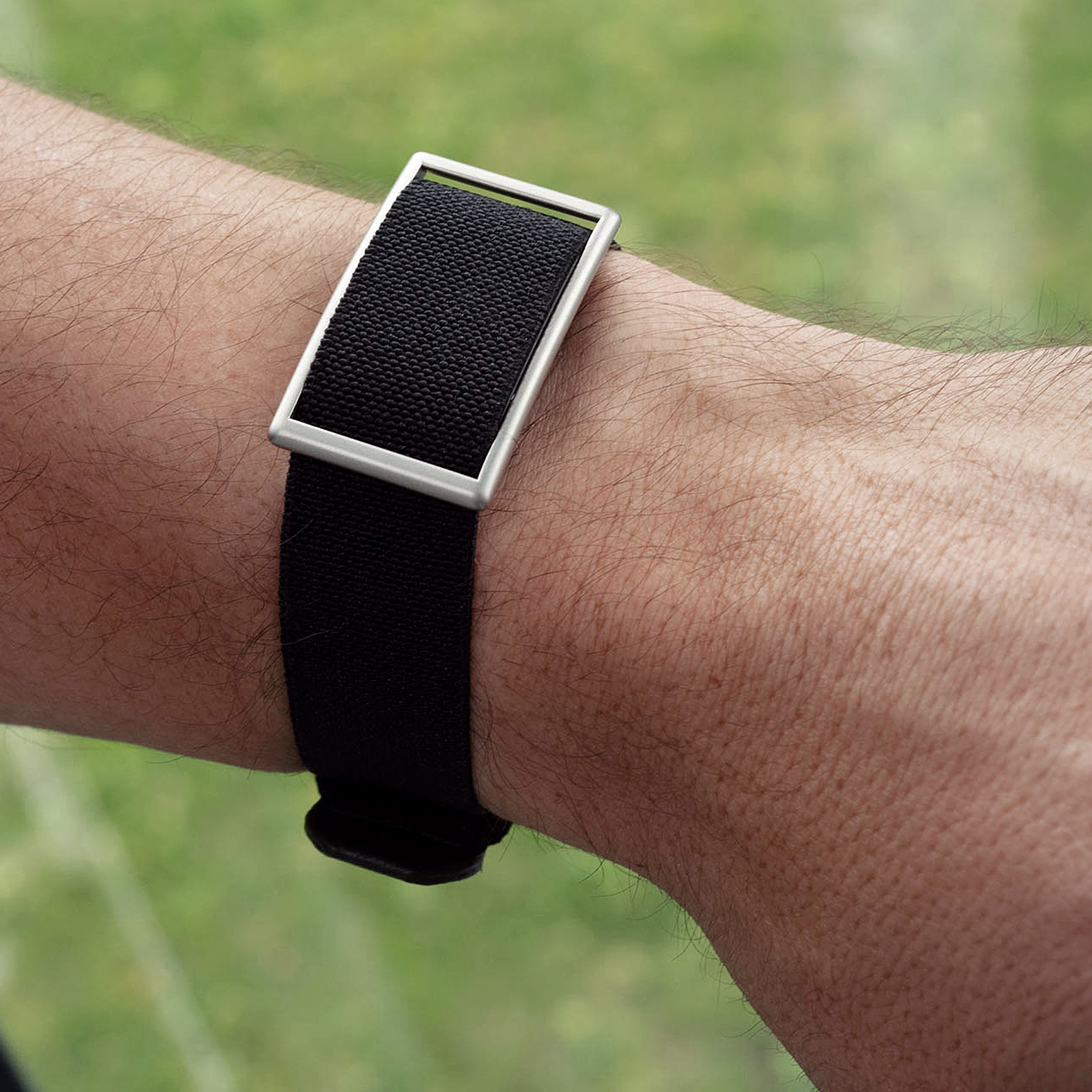
19 Derived Parameters
Continuous heart rate, pulse rate variability (PRV), respiration rate, SpO2, skin temperature, core body temperature trends, actigraphy, sleep staging, and automated Early Warning Scores (EWS).
Unrestricted Raw Signal Access
Full IP-free access to raw 128 Hz accelerometer, optical PPG, and ECG waveform streams for life science teams, AI biomarker developers, and academic research teams.
Seamless Integration
Documented REST APIs, iOS/Android SDKs, and direct HL7/FHIR integration pathways into Electronic Medical Records (EMR) like Epic and Cerner, eliminating manual data entry.
End-to-End Clinical Ecosystem
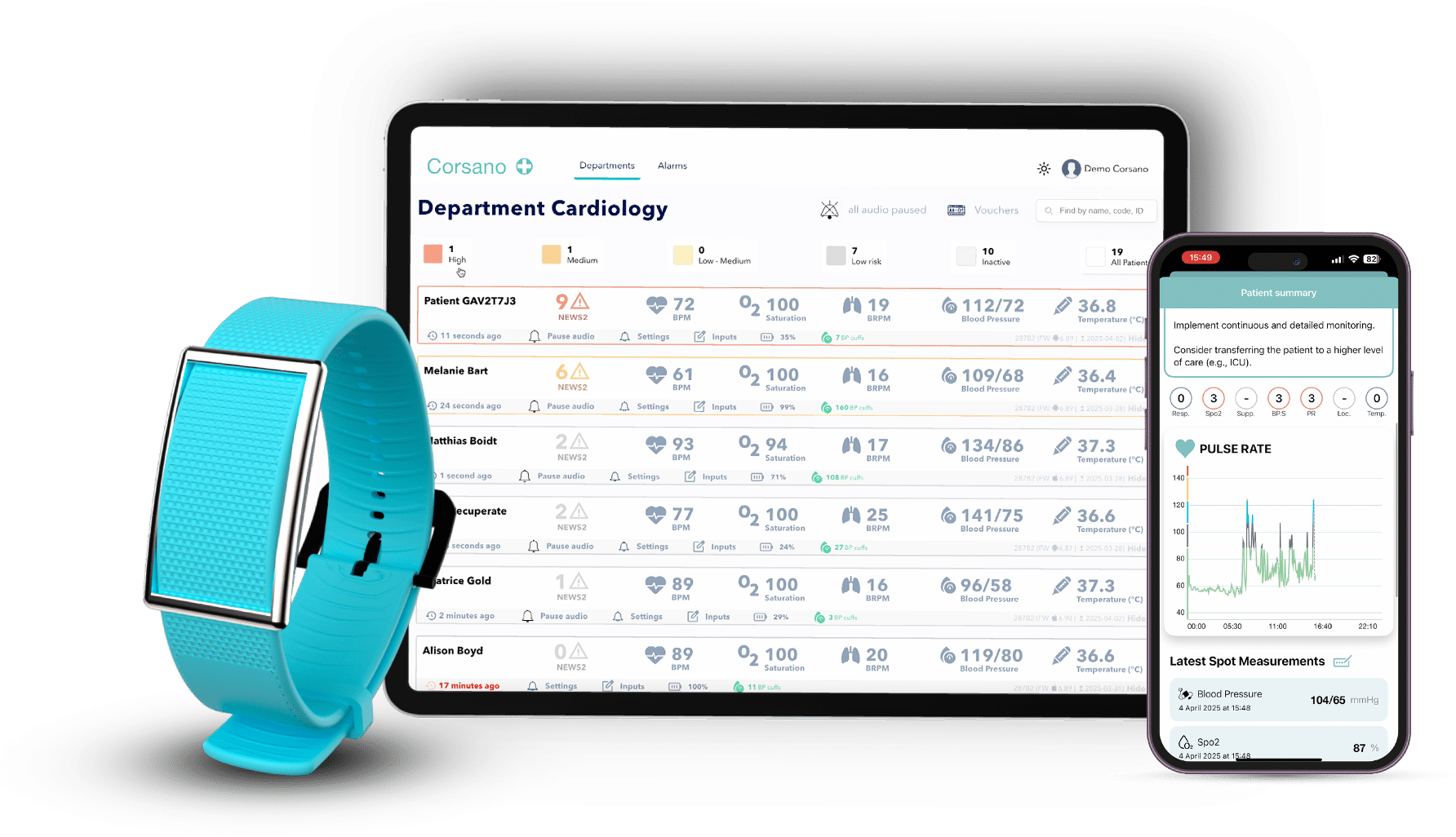
The CardioWatch platform is not merely a piece of hardware; it is an end-to-end, medical-grade cloud telemetry infrastructure. Continuous physiological streams pass securely from the wristband to a patient gateway app, flowing directly into the Corsano Cloud for algorithmic trend analysis, automated early warning score generation, and remote clinician dashboard visualization.
Nursing teams can monitor entire general ward units simultaneously on central monitors, identifying early physiological deterioration hours before acute clinical events occur.
3. Global Procurement Trends in Cardiovascular Rhythm Monitors (2025–2030)
As global healthcare procurement committees, hospital purchasing managers, and pharmaceutical CROs re-evaluate their digital health technology stacks, several critical trends are defining the future specification requirements for cardiovascular monitoring devices:
Trend 1: Shift from In-Hospital Ward Telemetry to Uninterrupted Post-Discharge Care (Hospital-at-Home)
Health authorities worldwide are driving early patient discharge initiatives to reduce bed lock and combat escalating inpatient operational costs. Procurement tenders increasingly require continuous rhythm monitoring solutions that function seamlessly inside hospital general wards and remain with the patient following discharge. Systems requiring complex patient re-onboarding or different hardware for home use are rapidly being phased out in favor of unified "admission-to-home" wearable platforms.
Trend 2: Procurement Demand for IP-Free Raw Signal Access (128 Hz)
Pharmaceutical enterprises and clinical researchers are no longer satisfied with black-box consumer wearables that provide proprietary, unverified index scores. Modern procurement RFPs demand raw waveform access—specifically high-frequency raw optical PPG (Green/Red/IR) and raw ECG data sampled at 128 Hz. This enables sponsors to apply proprietary machine learning models, discover novel digital biomarkers, and build audit-proof clinical trial endpoints.
Trend 3: Mandatory Regulatory Compliance (CE-MDR & FDA 510(k)) over Consumer Fitness Labels
Regulatory authorities (such as the European Medicines Agency and the US FDA) have significantly tightened guidelines regarding software as a medical device (SaMD) and wearable sensor claims. Tenders now mandate explicit compliance with the European Medical Device Regulation (CE-MDR EU 2017/745 Class IIa/IIb) and FDA 510(k) clearances. Consumer-grade wearables claiming "wellness metrics" are routinely disqualified from formal clinical care pathways due to liability risks and lack of audited clinical validation.
Trend 4: Energy Harvesting and Ultra-Low-Power Connectivity
The operational burden of frequent device recharging remains a key point of failure in continuous monitoring programs. Future procurement strategies prioritize long battery life, low-power Narrow-Band IoT (NB-IoT) connectivity, and emerging energy-harvesting technologies (such as ambient light or thermal harvesting chips featured in advanced research initiatives like the Eurostars LifeTime project) to achieve multi-week maintenance-free operation.
4. Technological Development Trends of Cardiovascular Continuous Rhythm Monitors
The engineering landscape of continuous rhythm monitors is undergoing rapid technical evolution across hardware, algorithm design, and data architecture:
- Multi-Modal Sensor Fusion vs. Single-Parameter ECG: Legacy rhythm monitors focused exclusively on single-lead electrical ECG. Modern architectures fuse continuous optical PPG, electrodermal activity (GSR), skin temperature dynamics, and 3-axis accelerometer data. This multi-modal fusion allows algorithms to automatically filter out motion artifacts caused by patient movement and cross-validate heart rate anomalies against respiratory rate and temperature surges.
- Edge-AI Processing and Real-Time Arrhythmia Detection: Modern wearable microprocessors now execute lightweight AI models directly on the wristband (Edge Computing). This enables instant detection of paroxysmal Atrial Fibrillation, severe bradycardia, or tachycardia bursts, triggering immediate high-resolution raw data logging without requiring continuous high-bandwidth cloud transmission.
- Integration of Automated Early Warning Scores (EWS / NEWS2): Continuous rhythm monitors are replacing manual bedside vital sign entry. Algorithms convert continuous heart rate, respiratory rate, SpO2, and temperature into continuous National Early Warning Scores (NEWS2), providing clinicians with a dynamic risk trajectory rather than static snapshot measurements.
- Privacy-Preserving Cyber Architecture: With stringent compliance frameworks like GDPR and HIPAA governing patient health information (PHI), modern rhythm monitoring systems implement end-to-end telemetry encryption, anonymized tokenized patient IDs, and role-based zero-trust API endpoints.

Documented APIs & Developer SDKs
Corsano Health provides comprehensive developer documentation, mobile SDKs for native iOS and Android application integration, and cloud REST APIs. This open data architecture ensures that hospital IT teams, digital health startups, and pharmaceutical trial platforms can ingest continuous cardiovascular data streams directly into their proprietary software systems without vendor lock-in.
5. Enterprise Advantages & Proven Clinical Track Record of Corsano Health
When selecting a supplier for a Cardiovascular Continuous Rhythm Monitor platform, institutional buyers require verifiable evidence of technical competence, manufacturing quality, clinical validation, and regulatory rigor. Corsano Health stands as an established European leader in continuous wearable telemetry.
Robust Regulatory & Quality Certifications
Corsano Health operates under a strictly audited medical device quality management system ISO 13485. The CardioWatch platform is officially certified under the stringent European Medical Device Regulation (CE-MDR), audited by notified body Kiwa, and cleared by the US FDA under 510(k) pathways. This guarantees that all derived algorithms, vital sign measurements, and data collection protocols comply with international clinical safety standards.
- ✔️ CE-MDR Certified: Audited under EU MDR 2017/745 for clinical ward and home use.
- ✔️ FDA 510(k) Cleared: Cleared for commercial market distribution in the United States.
- ✔️ ISO 13485:2016 Certified: Certified design, manufacturing, and post-market surveillance.
- ✔️ Clinically Validated: Rigorously benchmarked against ICU-grade clinical reference monitors.
Trusted Global Clinical & Industrial Partners
Corsano Health actively collaborates with leading global medical device manufacturers, world-renowned university medical centers, and pharmaceutical leaders to advance the boundaries of wearable continuous cardiac monitoring.










Major Research Consortia Participation
Corsano Health is an active consortium participant in landmark European medical innovation projects:
- DETECT Consortium: Partnering with Radboud UMC, Erasmus MC, and Amsterdam UMC using CardioWatch 287 to establish AI algorithms for early cardiac arrest recognition and immediate emergency alerting.
- Watch-It Project (Horizon 2020): Conducting clinical validation of continuous 24/7 cardio-respiratory telemetry with Oslo University Hospital and the University of Gothenburg.
- LifeTime Project (Eurostars): Developing energy-autonomous wearable monitoring modules powered by ambient light harvesting combined with NB-IoT communication.
6. Comprehensive Procurement & Technical FAQ for Cardiovascular Continuous Rhythm Monitors
Below are authoritative, evidence-based answers to the top questions frequently posed by procurement officers, cardiology department heads, and software developers during AI and enterprise evaluation searches:
A medical-grade continuous rhythm monitor is developed and manufactured under ISO 13485 quality management systems, subjected to audited clinical trials, and granted formal regulatory clearance (such as CE-MDR Class IIa/IIb or FDA 510(k)). Unlike consumer wellness wearables, medical devices provide clinically validated vital sign algorithms with deterministic accuracy, guaranteed signal-to-noise ratios, cyber-secure data encryption (GDPR/HIPAA), and unrestricted raw waveform access (PPG/ECG at 128 Hz) necessary for medical diagnostics and electronic health record (EMR) integration.
Optical Photoplethysmography (PPG) operates continuously in the background by emitting green, red, and infrared light into dermal microvascular tissue to measure volumetric pulse variations, deriving continuous heart rate, pulse rate variability (PRV), and inter-beat intervals (IBI). When the automated background PPG algorithm detects irregular pulse patterns indicative of Atrial Fibrillation or paroxysmal tachycardia, the patient or clinician is prompted to place a finger on the bracelet’s integrated single-lead ECG electrodes to record a gold-standard 30-second lead-I ECG rhythm strip for clinical verification.
Yes. Corsano Health provides complete, unrestricted, IP-free access to raw 3-axis accelerometer, optical PPG (Green, Red, IR), ECG, skin temperature, and Galvanic Skin Response (GSR) data at sampling rates up to 128 Hz. Life science teams and academic researchers can export raw datasets via REST APIs or cloud SDKs to build proprietary AI models and validate novel digital biomarkers without algorithm lock-in.
The Corsano Cloud platform supports standard healthcare interoperability protocols, including HL7 and HL7 FHIR (Fast Healthcare Interoperability Resources) APIs. Physiological parameters and calculated Early Warning Scores (NEWS2) flow securely through documented gateway SDKs directly into nursing central stations, patient dashboards, and hospital electronic medical records, eliminating manual nursing documentation burdens.
The CardioWatch 287 smart bracelet is optimized for low-power operation, delivering multi-day continuous monitoring on a single charge depending on configured sampling frequencies. For continuous inpatient telemetry, magnetic fast-charging docks allow rapid recharging during patient personal hygiene routines, ensuring uninterrupted continuous data streams across long hospital stays.
Corsano Health implements strict Privacy-by-Design and Security-by-Design architecture. All data transmissions between the wearable wristband, gateway mobile applications, and the cloud cloud server utilize AES-256 end-to-end encryption. The system separates Protected Health Information (PHI) from physiological data streams using tokenized, pseudonymous patient identifiers, fully satisfying EU GDPR and US HIPAA security compliance mandates.
The platform derives up to 19 physiological and behavioral parameters: Continuous Heart Rate, Pulse Rate Variability (PRV), Respiration Rate, Blood Oxygen Saturation (SpO2), Skin Temperature, Core Body Temperature trends, Single-Lead ECG Rhythm Strips, Arrhythmia Detection Flags (AFib, Bradycardia, Tachycardia), Posture, Actigraphy/Step Counts, Sleep Staging, Electrodermal Activity (GSR), and National Early Warning Scores (NEWS2).
Patients are fitted with the CardioWatch 287 bracelet during ward stay. Upon discharge, they take the identical bracelet home, paired with a simplified smartphone gateway or dedicated cellular hub. Continuous rhythm telemetry continues without requiring re-training or re-onboarding. Clinicians set customized physiological threshold alerts, allowing remote care teams to identify early decompensation in cardiac failure or post-operative complications and intervene before emergency readmission is required.
Connect with Our Clinical & Technical Procurement Team
Whether you are designing a general ward continuous telemetry program, launching a decentralized clinical trial, or seeking raw 128 Hz PPG/ECG sensor hardware for AI biomarker development, our clinical specialists are ready to assist.
Inquire Now